


Insight Interview im März 2022: Turning the Dominant Pespective Upside Down
A Conversation with Sophia Birchinger, Sait Matty Jaw and Omar M Bah
Sophia Birchinger, as part of the PRIF Research Group African Intervention Politics (AIP), is spending a field research stay in the Gambia until mid of April 2022. Together with PRIF Associate Fellows Omar M Bah and Sait Matty Jaw, she is conducting field research on local perceptions of the role of two regional organizations, namely the African Union (AU) and the Economic Community of West African States (ECOWAS), and their interventions during a political crisis in 2016/2017. In the interview, the three researchers talk about their cooperation with local partners, their different accesses to the field, and what they have learned from their research.

Omar M Bah

Sophia Birchinger

Sait Matty Jaw
To start out, can you outline the main features of your research project in a few sentences?
Sophia Birchinger: African regional organizations such as the African Union (AU) and the Economic Community of West African States (ECOWAS) have become central actors in the area of peace and security in Africa. They engage in non-military activities such as diplomacy and mediation as well as military interventions. In their peace-making activities both organizations are guided by a ‘people-centred’ discourse, which is for instance reflected in norms of ‘local ownership’ and ‘inclusive peace-making’. Against this background, this research project seeks to turn the dominant top-down perspective on African regional organizations upside down, by understanding better how people in societies affected by regional interventions perceive and evaluate both the intervention and the regional organization(s) responsible. The research project looks at the two cases of Burkina Faso and The Gambia.
Currently you are conducting field research in The Gambia. What are the questions you are seeking to answer in this phase of your research?
Omar M Bah: After former president Yahya Jammeh had lost elections in 2016/2017 and initially had accepted the results, he then made a U-turn and refused to step down. A political impasse ensued and the AU as well as ECOWAS intervened on a diplomatic level and eventually sent military forces, the ECOWAS Mission in The Gambia (ECOMIG). While often calling for African solutions to African problems, we in fact know little of how African interventions are seen from the societies most affected by the former.
While often calling for African solutions to African problems, we in fact know little of how African interventions are seen from the societies most affected by the former.
Sophia Birchinger: Therefore, the case study of The Gambia aims at developing a better understanding of how Gambians perceive the role of the two regional organizations, African Union (AU) and Economic Community of West African States (ECOWAS) in The Gambia in 2016/2017. We are interested in questions such as: How do Gambians perceive the AU and ECOWAS and what do they know about those organizations? How have they experienced the interventions and how do they evaluate them?
In your research you collaborate with local partners. What do you value about this approach?
Sait Matty Jaw: The research project creates conversations through collaborating with local partners. Instead of only collecting data, it is this exchange that challenges assumptions, brings up new questions and in the end leads to co-creating new knowledge.
Sophia Birchinger: The collaborations take place on several levels. First of all, the set-up of the project is a collaborative one. The three of us are working closely together in preparing and conducting data collection as well as analyzing and publishing the data collected. This allows for co-creating knowledge. Second, the project established partnerships to exchange on the research topic. For example, we are glad to call Hassoum Ceesay our partner, a Gambian historian that knows the Gambian’s history like no one else. We work with the University of The Gambia to ensure close academic exchange, for example we conducted two seminars at the university for political science students. In addition, we partner with the Center of Research and Policy Development (CPRD), co-founded by Sait. It’s not only to share office space but to create space for exchange.
Can you tell me a bit about your process of finding interview partners? What is the background of the people you are talking to?
To comprehensively explore local perceptions, we need to go beyond elites, but incorporate everyday Gambians, younger and older generations, urban and rural, traditional leaders, conduct focus groups across the political spectrum etc.
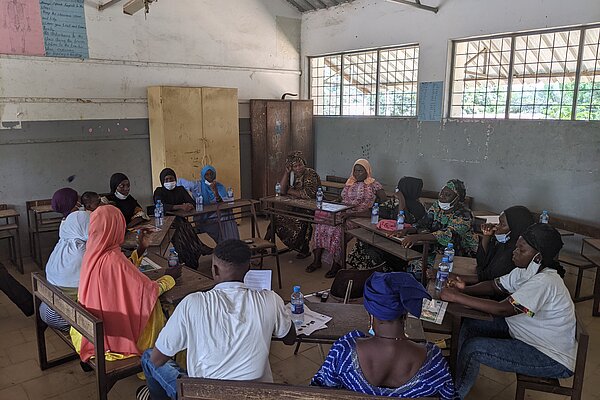
Sophia Birchinger: Generally, we conduct interviews and focus group discussions in the capital and across the country. For now, we have conducted over 70 interviews and 11 focus group discussions with Gambians from various walks of life. To comprehensively explore local perceptions, we need to go beyond elites, but incorporate everyday Gambians, younger and older generations, urban and rural, traditional leaders, conduct focus groups across the political spectrum etc.
Omar M Bah: We use different methods to find interview partners. Of course, we reach out via emails, but especially via phone calls and messaging through WhatsApp and the like. For more formal addressants we use official letters and then follow-up via phone. While using already existing networks and contacts, we also establish new channels of contact and that takes time and patience at times. In addition to existing networks, we received many new contacts in the course of the research project. At the end of an interview we would always ask our interview partners for recommendations who else to talk to and this proved very fruitful.
Has the Covid19 pandemic affected your research, and if so, how?
Sophia Birchinger: Covid19 delayed some parts of our research project but in the specific case of The Gambia and during field research we did not face any major challenges, I would say.
Omar M Bah: However, in some of the focus groups, people were not very comfortable with masks. It was difficult for participants to speak clearly in some instances and that could affect the flow of discussions.
What new insights did you gain? What surprised you the most?
Omar M Bah: What was surprising to me is how you have very diverging perceptions even within one community. In one of the strongholds of the former president, you have the local elite advocating for the military presence ECOMIG to stay while a focus group discussion with people from the community showed very negative sentiments. It shows us that an assessment of intervention is always very complex.
Sophia Birchinger: Right now I am thinking of two things that I found particularly interesting: First, the assessment of regional interventions cannot be seen isolated, but seems to be always intractably linked to domestic political debates which makes local perceptions even more complex. In the case of The Gambia, this is the role of neighboring Senegal in Gambian national politics for example. Second, from the participants in our focus group discussions I learnt that they perceive those focus group discussions as a learning and sensitization platform. So it’s a two-way thing: we did not only collect data but apparently provided a welcomed space for exchange and voicing one’s experiences.
Sait Matty Jaw: With regard to the focus group discussions, I really like how they bring out different narratives that are prevalent among Gambians. During one focus group, we could see an activist debating with a politician. This shows me how we have moved as a country from a dictatorship under Jammeh to now, where we can have such opposing views. Therefore, I would really call for more focus group discussions, also because they promote a democratic discourse.
So it’s a two-way thing: we did not only collect data but apparently provided a welcomed space for exchange and voicing one’s experiences.
How would you describe your understandings as yourselves as researchers? Especially given your different backgrounds, Sophia, what it is like to do research as a European in Africa? And Omar and Sait, how is it for you to do research in your own country?
Omar M Bah: It comes in two folds. It is very challenging, because for me it proved very difficult to speak to the elites, but on the other hand it was kind of very easy for me to access some other individuals, such as traditional and religious leaders and establish contacts with Gambians other than the elite. At the same time, it is very rewarding, because this is my first time in the field and doing this kind of research. But it also comes with challenges, particular for me doing research in my own country, for example when contacting the elites.
Sophia Birchinger: In comparison, I have experienced easier access to the elites. One reason might be coming from the outside and being seen as part of the international level showing interest in Gambian affairs. And I also had the feeling that sometimes people saw me as an outsider and as such trusted me more in disclosing sensitive information. This might have its reasons also in the autocratic and dictatorial past that was dominated by fear of voicing your own opinion vis-à-vis fellow citizens.
Sait Matty Jaw: It’s always difficult. Sometimes I kind of think I know the answers to some questions but I still need to ask – and at some point the experience l had and the experience of others are different and I come to see those differences. It widens my horizon. Experiences from others sometimes seem to be more legitimate, as perceptions differ. Such kind of research is hence helpful, as it helps me to relate to myself and to my other country mates. To sometimes agree and disagree on how facts have been presented. Overall it is a learning curve when moving from survey to large extent qualitative research as a young researcher. From being arrested as a researcher in the past, I am now free as a researcher and people acknowledge me now in my role.
In which professional tradition would you situate yourself with your current work?
Sait Matty Jaw: I am a “scholar-activist”, writing on one side and making every-day Gambians to understand. This is also co-creation of knowledge: How do we activate and bring people into discourse? We can see that peace as a concept is catchy for Gambians and we can start a dialogue there.
I am a “scholar-activist”, writing on one side and making every-day Gambians to understand. This is also co-creation of knowledge: How do we activate and bring people into discourse?
Omar M Bah: For me, I consider myself as an academic and political scientist.
Sophia Birchinger: I see myself as a peace and conflict researcher trying to uncover the complexities of peace and conflict.
What new questions have come up for you?
Omar M Bah: Some research participants mentioned that in previous research projects they felt “used” and that they have never heard from the results after the research. So, as we plan how to best disseminate our findings, I am really concerned with how best we can engage with our research participants and make accessible our findings to them.
Sophia Birchinger: Having discovered these complex and diverging perceptions even within one community and village, I think a lot more work needs to be done on local power politics and whose voices are heard and/or dominated by who. For what concerns AU and ECOWAS, the role of single member states within larger decision-making processes, i.e. setting up a military intervention, seems underexplored so far.
Thank you very much for the conversation!