



| 2024
Ghattas, Sally; Mannitz, Sabine; Moses, A. Dirk; Reitz, Núrel Bahí (2024): Transformations in Genocide Discourse: Paths and Politics of Recognizing Colonial Genocides, TraCe Working Paper, 4, Frankfurt/M . DOI: 10.48809/PRIFTraCeWP2404
 Download
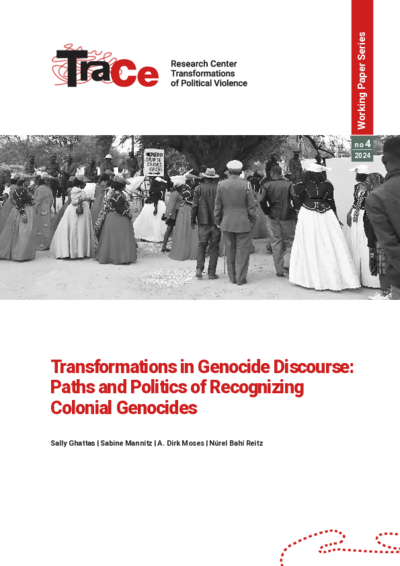
This working paper focuses on the changing discourse and unfolding politics of redress surrounding mass crimes committed during colonization processes. After decades of silencing the violence inherent in colonialism and its lasting consequences whether within post-colonial states, settler colonial states or in international relations recent years have witnessed acknowledgements of colonial atrocities as genocide. Truth commissions were established to uncover the histories of dispossession, displacement, cultural oppression, enslavement, and mass killings in colonization processes. The study of colonialism, furthermore, has raised the question whether settler colonialism should be characterized as an inherently genocidal project. The authors present drivers and paths of this discursive transformation as well as the unfolding politics of recognizing the violence of colonial history. They draw on their research in the cases of Australia, Canada, and Namibia to address these moments of transformation. The paper’s goal is to follow said discursive changes with an eye to their meaning for the broader aim of overcoming systemic violence, indifference, and injustice in (post-)colonial settings.