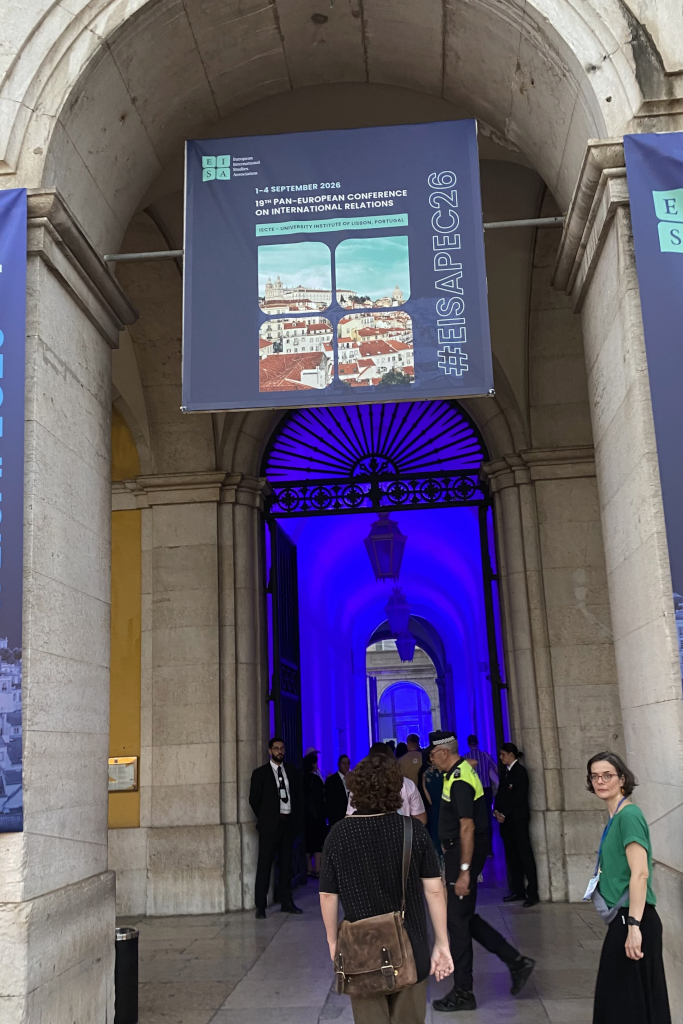
Under the theme “Even better than the real thing? Questioning knowledge production, positionality, and authenticity in IR,” the 19th Pan-European Conference on International Relations (PEC), organized by the European International Studies Association (EISA), took place in Lisbon from September 1 to 4, 2026. PRIF was once again represented this year by numerous scholars who shared their papers for discussion in the diverse thematic sections, participated in various discussion formats, or even chaired panels and sections themselves.
From the Research Department International Security, research by Christopher Daase, Jana Baldus, Caroline Fehl, Veronika Klymova, Frank Kuhn, Clara Perras, Liska Suckau and Simone Wisotzki was presented in a broad range of sessions. On the first day of the conference, Christopher Daase contributed a comparative perspective on competing contemporary analyses of the current state of international relations to the session “Theory on International Order and Its Crisis.” Contrary to the dominant portrayal of a binary rivalry between realist and liberal positions, he outlined the paradigms of a republican approach that enables a new way of thinking about European security.
At the same session, the Research Department International Institutions contributed a joint conference paper by Nicole Deitelhoff, Johanna Speyer, Felix Bethke, Jonas J. Driedger, Ivan Kharitonov and Mina Trpkovic titled “Stability and Crisis in International Orders: Theoretical and Empirical Perspectives.” The authors propose a more in-depth conceptualization of stability and crises and, based on this, develope empirical indicators to better identify crises of order and assess their severity. In addition, Fumie Nakamura, Mikhail Polianskii and Xinyu Yuan each shared their papers in the sessions “Transnational City Networks: Knowledge, Power, and Global Governance”, “Intelligence Beyond the Anglosphere” and “China, Russia, and the LIO.”
From the Research Department Transnational Politics, Claudia Baumgart-Ochse and Isabelle Stephanblome attended the conference. The former addressed the role of religious NGOs in global politics and the German churches’ relationship with Israel and Palestine in two sessions. In the session “Counterterrorism Practices,” Isabelle Stephanblome presented her analysis of German legislative practices in the fight against terrorism, in which she highlighted the interplay between the legitimizing structures of a state of emergency and those of normality.
Pascal Abb from the Research Deparment Intrastate Conflict discussed a paper he co-authored with Jonas Wolff and Piki Ish-Shalom (Hebrew University of Jerusalem) during the session titled “The Autocratic Toolkit: Foreign Interference and Narrative Warfare.” In it, the authors examine the discursive tactics and contradictions that characterize China’s attempt to portray its political regime as a unique yet superior democracy. Yaolong Xian, in turn, analyzed Chinese foreign policy through the lens of its engagement in Myanmar, which is carried out through non-state actors. In addition, Christin Stühlen used the example of coal-dependent communities in Bosnia to illustrate how semi-peripheral regions in Southeast Europe are finding their place in changing global (energy) orders.
The Research Department Local Peace Orders contributed work by Sabine Mannitz, Núrel Bahí Reitz and Sophia Birchinger. In the panel “Addressing Legacies of European Colonial Violence: Local Perspectives and Activism,” the presentation by Mannitz and Reitz focused on the ambivalent role of the law in post- and decolonial struggles. Drawing on the examples of Canada and present-day Namibia, they demonstrate in their paper “From Legalized Violence to Legal Resistance: Contesting Colonial Injustice through Law,” how activism centered on the memory of genocide reshapes legal frameworks. However, unequal access and state-centered frameworks can reproduce the very hierarchies that these movements seek to overcome. Sophia Birchinger presented two papers at the sessions “Theorizing Knowledge in IR: Strangers, Paradoxes, and Disobedience” and “International Organizations, International Norms, and Global Ordering” and also participated in the “Roundtable on Institutional Care and Carelessness in Fieldwork.”
Detailed information about this year’s EISA-PEC program and the presentations by PRIF researchers can be found on the conference website.