


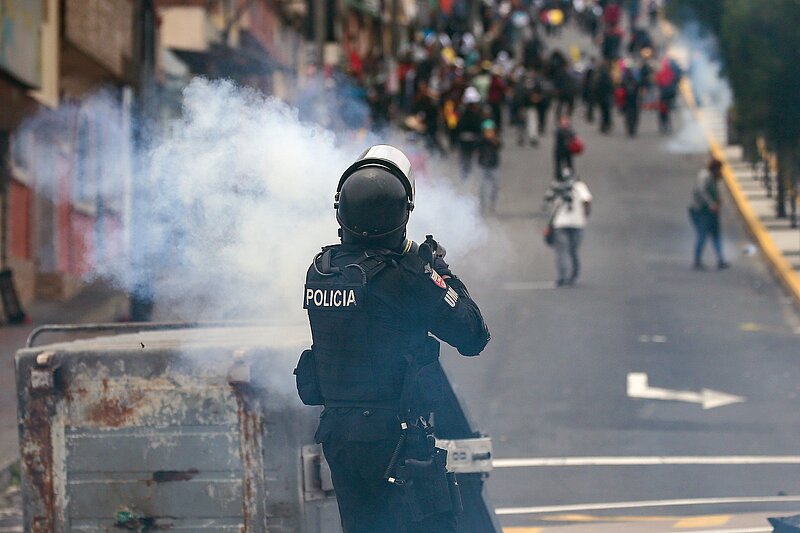
In recent years, Ecuador is experiencing an unprecedented surge in criminal violence. The government under President Daniel Noboa declared an “internal armed conflict” and deployed the armed forces to combat crime. In the name of the fight against organized crime, the government has also implemented measures that restrict civic space. This dual challenge particularly affects activists, civil society organizations, and social movements.
Although there have been some initial studies on the implications of criminal violence for Ecuadorian civil society, analyses of the effects of the combination of criminal violence and the state’s repressive, militarized response are lacking. Drawing on workshops and interviews with representatives of social organizations, complemented by primary and secondary sources, Elena Dressler, Madeleine Palacios and Jonas Wolff analyze the consequences of this double challenge for activists, organizations, and social movements in Ecuador. The report likewise explores the responses that civil society organizations (CSOs) are developing in the face of this dual challenge. Based on this assessment, recommendations are formulated for international cooperation.
The report confirms a significant deterioration of civic space. On the one hand, criminal violence and the territorial presence of criminal groups hinder the work of human rights defenders, weaken CSOs, and affect their relationships with communities, prompting a reconfiguration of their field of action. On the other hand, we observe strong dynamics of police-military repression, both in relation to social protest and in the context of operations against organized criminal groups (OCGs). In addition, the report identifies a series of legal and administrative restrictions, as well as discursive delegitimization. The study also reveals differentiated effects depending on (sub)region and type of actor.
The research for this publication was conducted as part of the research project “Violence Against Social Activists: Causes, Patterns, and Transformations.” The project is part of the Research Center “Transformations of Political Violence” (TraCe), which is funded by the Federal Ministry of Research, Technology, and Space (BMFTR).
Dressler, Elena; Palacios, Madeleine; Wolff, Jonas (2026): Activismo y Movilisación Social en Tiempos del “Conflicto Armado Interno” en el Ecuador: Perspectivas, Experiencias y Respuestas desde la Sociedad Civil, PRIF Report, 2, Frankfurt/M. DOI: 10.48809/prifrep2602
Download the report here.