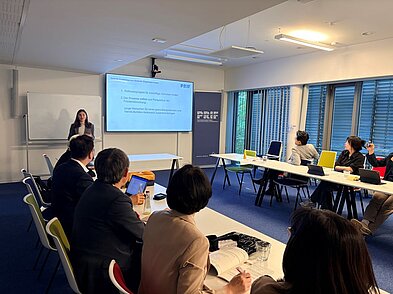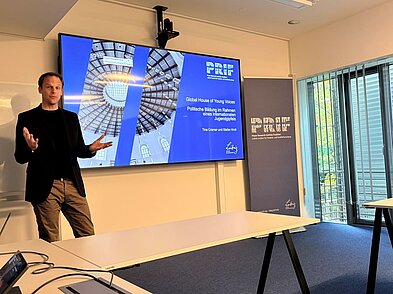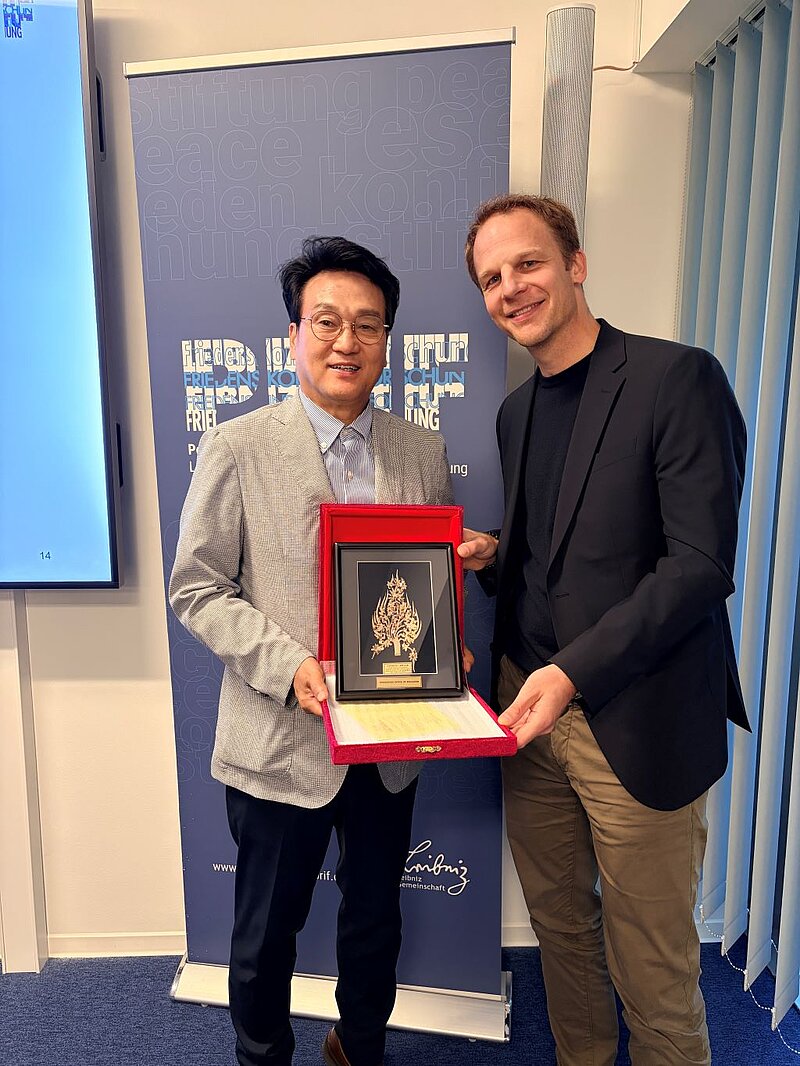
On September 23, 2026, Tina Cramer and Stefan Kroll welcomed a delegation from the Gyeonggi-do Office of Education in South Korea to PRIF. The meeting focused on an exchange regarding science communication and collaboration with schools.
Tina Cramer and Stefan Kroll introduced the delegation to the Global House of Young Voices and the #PRIF@Schule Award. The Global House of Young Voices was a one-week summit held in 2024 that brought together youth delegations from Frankfurt and 12 partner cities. The PRIF@Schule Award is presented every two years – with rotating thematic focuses – to recognize innovative and creative works and projects that address topics in peace and conflict research in local, national, and international contexts.
Following the meeting, Hyejin Na, supervisor of the Global Cooperation Division at the Gyeonggi-do Office of Education, expressed her gratitude for the exchange: “What we came for was not peace studies in the abstract, but the question of how research reaches a classroom – and that is your work exactly. Our Superintendent said afterwards that the conversation had given him something he had not expected: a way of thinking about how universities and research institutes might be connected to schools in Gyeonggido, rather than remaining a world apart.”
Science communication is an essential component of research at the PRIF. Research findings are disseminated through various formats of policy advice and civic education. At the same time, input from society is incorporated so that researchers can integrate it into their work.