


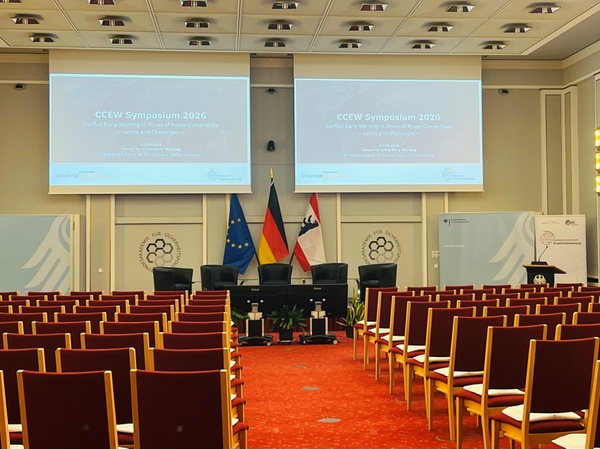
In October, international experts from research, think tanks and ministries concerned spent two days discussing the limits and challenges of conflict early warning, forecasting and foresight. How will crisis early warning systems evolve in an era of interstate conflict, geopolitics and hybrid threats? What impact will the use of AI and large language models have? What new approaches and methods are being developed for conflict forecasting and strategic foresight?
Six panels and three seminars contributed to an interdisciplinary exchange on these various aspects of effective early detection and foresight, and enabled discussions between researchers and decision-makers.
Antonia Witt is one of the project leads of JOSHUA – AI-based Scenario Development, a research project at PRIF in cooperation with the chair “Science and Technology for Peace and Security” and the “Artificial Intelligence and Machine Learning (AIML) Lab” at TU Darmstadt, as well as the German Research Center for Artificial Intelligence (DFKI). At the CCEW Symposium, she led a workshop on the possibilities of AI-supported foresight and scenario development and, together with Dominik Hintersdorf and Marlon May (both DFKI), presented the project’s research and development results to date. The system developed in JOSHUA uses language models and agent-based modelling to simulate conflict dynamics. This makes it possible to interactively explore different “what-if” scenarios for interstate and intrastate conflicts, test strategies, and reflect on escalation and de-escalation dynamics. In her presentation, Antonia Witt emphasized that, beyond processing large volumes of data, artificial intelligence can be used in strategic foresight as a “creative partner” to broaden the imaginative horizon for multiple future pathways. At the same time, this requires responsible, transdisciplinary and transparent development and use of AI-based systems, with human-machine interaction always subject to critical and ethical reflection.
The CCEW Symposium is organized annually by the Center for Intelligence and Security (CISS) at the University of the Bundeswehr Munich and took place this year at the Federal Academy for Security Policy in Berlin. It is supported by the Federal Ministry of Defence and the Federal Foreign Office.