Modeling the China-Taiwan conflict: scenarios and escalation dynamics
The Taiwan question represents one of the most critical geopolitical fault lines of the 21st century: a rising China is forcefully pressing for unification with Taiwan, which has evolved a distinct political identity that strongly emphasizes the island's independent and democratic character. Recent years have seen an increase in Chinese military and “gray zone” activities in the Taiwan Strait, significantly heightening the risk of violent escalation – whether intentional or not. Given the economic importance of both China and Taiwan, a global semiconductor production hub, such an escalation would have far-reaching repercussions and significantly impact Germany and Europe. These concerns are a major driver of current attempts to “de-risk” economic ties with China and have sparked a new interest in understanding the roots and dynamics of the conflict.
This project aims to deliver actionable insights by developing a range of escalation scenarios, identifying common pathways to escalation and exploring opportunities for conflict mitigation and management. It focuses on designing complex multi-actor scenarios for an escalation in the Taiwan strait and further developing PRIF’s JOSHUA scenario modeling system for escalation dynamics simulation. Its main deliverables consist in a fully interactive scenario that can be explored in war-gaming exercises and actionable insights into conflict impacts and options for European actors. These will be made available through transfer publications and consultation offers.
The project brings together expertise from the fields of China and Taiwan studies, AI modeling as well as peace and conflict research. It is embedded in the Leibniz Research Network China.
It is part of a planned future research initiative whose goal is to integrate analyses of escalation scenarios for the China-Taiwan conflict based on the JOSHUA scenario modeling system with economic impact assessments of trade disruptions (e.g., blockades or sanctions) to be expected in the context of corresponding scenarios based on quantitative trade models. The planned initiative is to be carried out in collaboration with the Kiel Institute for the World Economy.
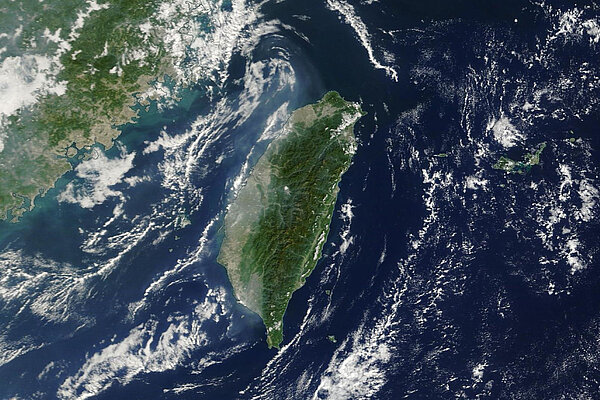
Image: Taiwan Strait via NASA Worldview


Publications
- Who Can Keep Taiwan at Peace? Security Politics in the 2026 Local Elections and the Road to 2028
| 2026
Zhou, Vicoria S. (2026): Who Can Keep Taiwan at Peace? Security Politics in the 2026 Local Elections and the Road to 2028, PRIF Spotlight, 19, Frankfurt/M. DOI: 10.48809/prifspot2619
 Download