


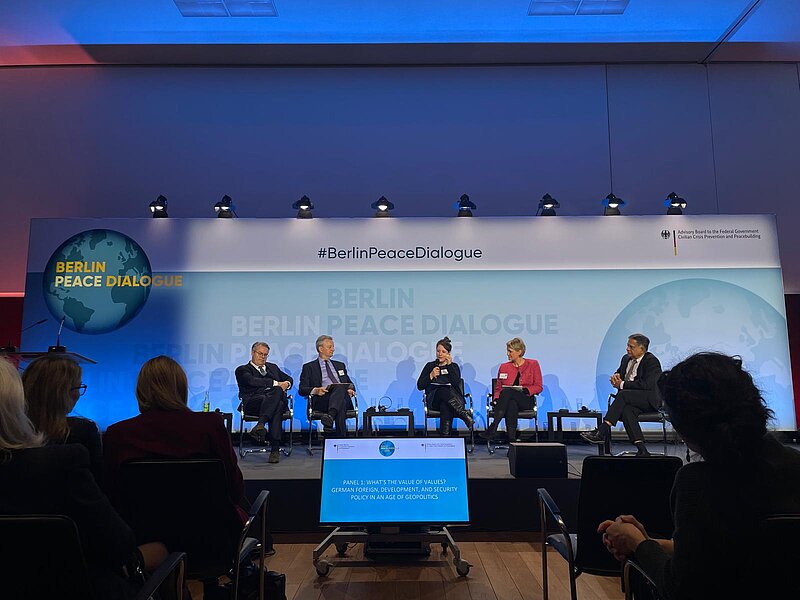
The visible rivalries between world powers are exacerbating the already smouldering conflicts over resources, zones of influence and the interests of different political systems. How can a value-based and interest-driven foreign and development policy maintain its own credibility in these “shrinking spaces”? And how much room is there for civilian crisis prevention and peacebuilding in a foreign policy characterized by security policy considerations of stability and armament? These questions were discussed by representatives from politics, academia and practice at the annual conference of the Advisory Board for Civilian Crisis Prevention and Peacebuilding (Berlin Peace Dialogue 2024) on November 5, 2024.
PRIF was represented on two panels by Sarah Brockmeier-Large and Antonia Witt, who is a member of the Advisory Board for Civilian Crisis Prevention and Peacebuilding. Sarah Brockmeier-Large discussed the effects of wars, political crises and budget cuts on German support in conflict areas as well as the credibility of a “values-based” German foreign policy with Minister of State Tobias Lindner (B90/GREENS) under the motto “What's the Value of Values?”. “There is a real danger that all the efforts, evaluations and recommendations for action currently being developed will fall by the wayside, especially after the US election, and that nothing will change. There simply won't be enough capacity, time or money,” the PRIF panelist stated right at the start. With regard to crisis prevention and the German form of strategy development, she also warned that “in many cases, there is a lack of a political strategy to apply the instruments and analyses we have in certain conflicts in a meaningful way”.
Antonia Witt moderated the “Civil Society and Peace” panel with State Secretary Bärbel Kofler (SPD), among others, which focused in particular on the creative power of civil society actors in (post-)conflict contexts and the effectiveness of transnational support. The panel participants emphasized the immense importance of gender equality for civil peacebuilding as well as the central role of confidence building and trauma management, as examples from Eastern Ukraine and the Gaza Strip show. With a view to strengthening civil society initiatives and capacities, Rana Salman from Combatants for Peace, for example, called for efforts for a locally-led peace initiative that could be supported by the international community, thus highlighting the potential of transnational civil society peacebuilding.
A recording of the English-language panels and discussions is available on YouTube.
The Advisory Board Civilian Crisis Prevention and Peacebuilding brings together civil society and academic expertise and advises the work of the German government. The twenty members of the Advisory Board, including Antonia Witt, come from the fields of international cooperation, science, foundations and non-governmental organizations and are appointed for four years. The committee supports the implementation of the guidelines “Preventing crises, managing conflicts, promoting peace” adopted by the Federal Government in 2017.