


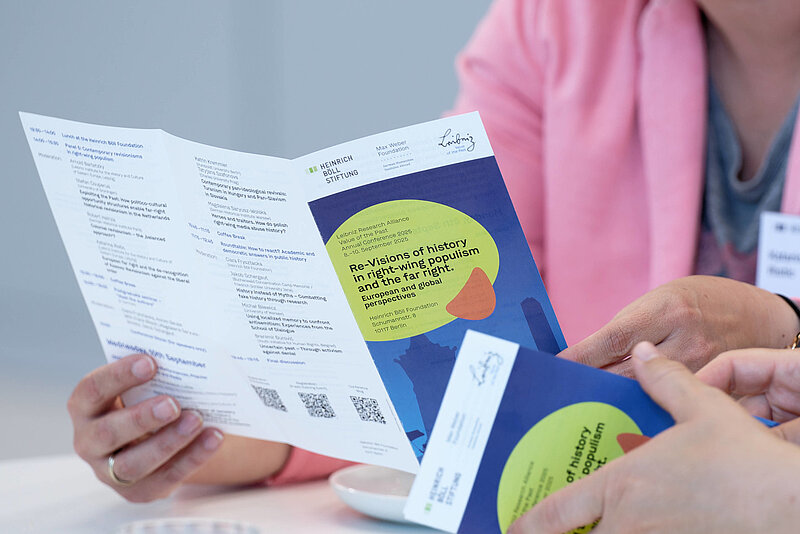
On September 8–10, the Annual Conference 2025 of the Leibniz Research Alliance “Value of the Past” took place in Berlin. It addressed the question of how right-wing populist and extreme right-wing parties and actors attempt to challenge socially established and research-based understandings of history and reinterpret the past according to their own ideas. Bringing together global and European perspectives, participants discussed denial, obfuscation, myth-making, revisionism, strategically deployed counter-narratives, national patterns of justification, and narratives of past national greatness and necessary rebirth as central components of right-wing views of history.
PRIF’s Sabine Mannitz co-organized the Annual Conference together with her Research Alliance colleagues. On the first day of the conference, she moderated the panel discussion on Global Perspectives that looked at right-wing populist movements and far-right thinking in the US, India, and Japan. Richard Steigmann-Gall (Kent State University) opened the panel with his presentation on the question of Collective Memory and Fascism in the United States. He demonstrated that, as with historically fascist regimes, contemporary fascism takes a distinctively conservative turn when seeking to recenter questions of national grandeur – deploying categories of race, religion, gender and class.
Srirupa Roy (University of Göttingen) continued the discussion on strategic mobilization of histories. Her paper on the Hindu nationalist right in India showed how actors surprisingly borrow from the progressive left/liberal political repertoire of calls for decolonization and for recognizing the universal values of Indian civilization. David M. Malitz (German Institute for Japanese Studies, Tokyo) offered insights into a comparatively young actor: the Japanese right-wing populist “Do-It-Yourself Party” (Sanseitō). Based on its historical narratives and concepts of identity, he described why right-wing populist narratives in Japan – unlike in Europe and North America – have long found relatively little resonance at the ballot box, but are now clearly gaining support.
Around 80 participants took part in discussions in the various formats offered by the conference. The public evening event, “Right-wing historical myths. A challenge for society, academia, and politics”, was also well attended, with 350 participants (120 of whom via livestream).
The Leibniz Research Alliance comprises 21 institutions and numerous international partner organizations. The network's research is based on the question of what value the past is given in societies of the past and present. In joint projects, which may have a German, European or a global dimension, the participating institutes investigate how historical evidence is shaped by language, mediality and digitality. Sabine Mannitz, head of PRIF’s Research Department Glocal Junctions and Principal Investigator at the Research Center Transformations of Political Violence (TraCe) represents PRIF in the alliance.
Its 2025 annual conference was co-organized by the institutes of the Max Weber Foundation and the Heinrich Böll Foundation. Further organizers included:
- Achim Saupe (Leibniz Center for Contemporary History Potsdam, Leibniz Research Alliance “Value of the Past”)
- Clara Frysztacka (Heinrich Böll Foundation)
- Magdalena Saryus-Wolska (German Historical Institute Warsaw), together with Arnold Bartetzky (Leibniz Institute for the History and Culture of Eastern Europe)
- Frank Bösch (Leibniz Center for Contemporary History, Potsdam)
- Barbara Christophe (Leibniz Institute for Educational Media – Georg Eckert Institute)
- Paula Diehl (University of Kiel/International Populism Research Network)
- Heike Liebau (Leibniz-Zentrum Moderner Orient)
- Mascha Neumann (Leibniz Center for Contemporary History, Potsdam, Leibniz Research Alliance “Value of the Past”)
- Christian Rau (Leibniz Institute for Contemporary History, Munich)
- Karin Reichenbach (Leibniz Institute for the History and Culture of Eastern Europe)
- Hans-Ulrich Wagner (Leibniz Institute for Media Research – Hans-Bredow-Institute)
For a comprehensive overview of the panels, the abstracts and a short presentation of the panelists, as well as the other conference formats, please visit the Annual Conference’s blog. Further information on the Research Alliance’s work can be found on its website.