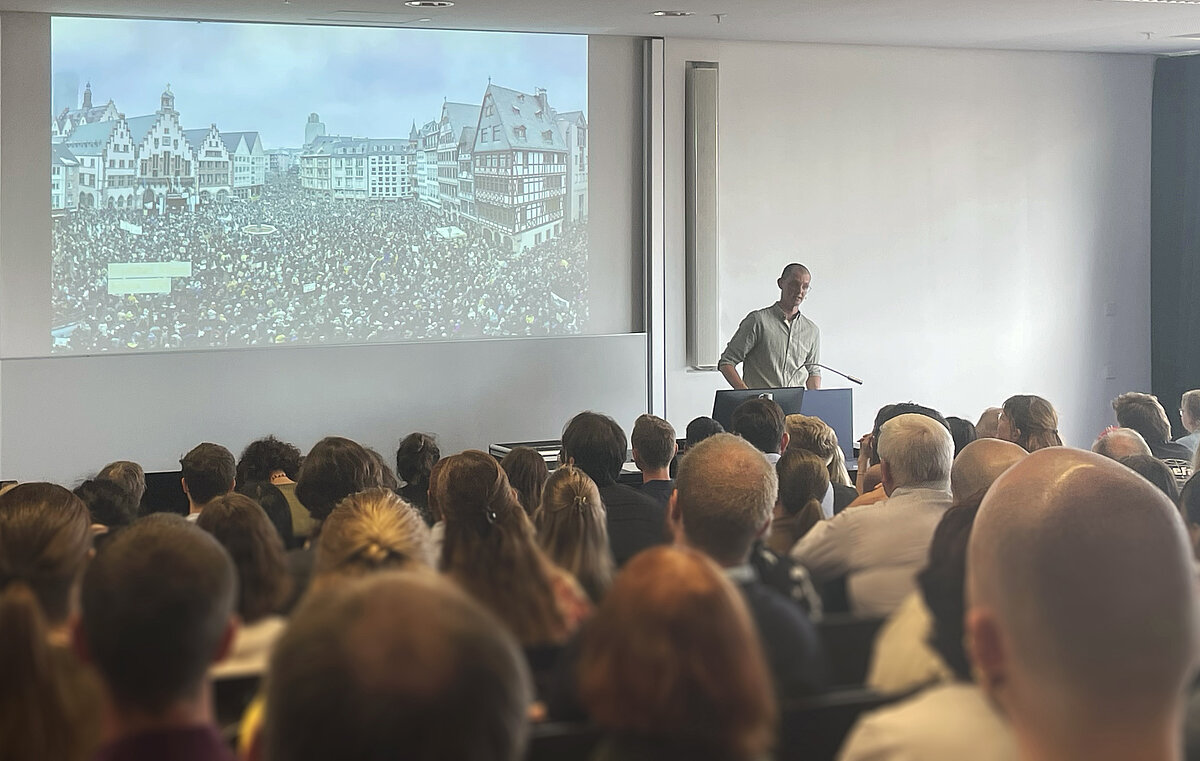
Can the concept of the “right to the city” be harnessed as a response to the rise of authoritarian forces? With his lecture on this topic on July 8, 2026, Daniel Mullis completed his habilitation process at Goethe University.
The starting point for the lecture was the call for a “right to the city,” a concept coined by the French urban researcher and philosopher Henri Lefebvre: For him, the right to the city means a framework for self-determined living beyond the logic of economic exploitation—freedom, self-actualization, housing, participation, and appropriation. Thus, the call for a right to the city also has a profoundly democratic character.
Cities have often been starting points for social movements. Consider, for example, the Arab Spring or the Occupy protests of the 2010s, which Mullis has also researched in Athens. Multicultural cities like Frankfurt am Main are, in a sense, the antithesis of an ethnonationalist worldview. At the same time, however, cities are also places of far-right politics where authoritarian forces can gain a foothold. Although the far right generally performs worse in large cities, it can still achieve success there, particularly in the urban periphery.
In his lecture, Mullis described two patterns he had observed in his own empirical research: The AfD was able to gain support particularly in neighborhoods with a history of industrial decline, but also in privileged neighborhoods with a long tradition of conservative voters. He also addresses this “regression of the center” in his book on “The Rise of the Right in Times of Crisis.”
While there is no automatic link between downward social mobility and support for authoritarian forces, experiences of frustration and a lack of participation make a shift to the right more likely. In this respect, the right to the city—with its emphasis on self-determination and political participation for all who live in the city—can serve as an alternative to the conditions that have fostered the rise of the far right. Mullis concluded his lecture with a call for utopia and plurality, which, he argued, consists precisely in making the niches and fissures within a system visible.
Daniel Mullis’s habilitation was based on his research at PRIF between 2017 and 2025 and includes several scholarly articles as well as the book “Der Aufstieg der Rechten in Krisenzeiten. Die Regression der Mitte”, published by Reclam in 2024.