


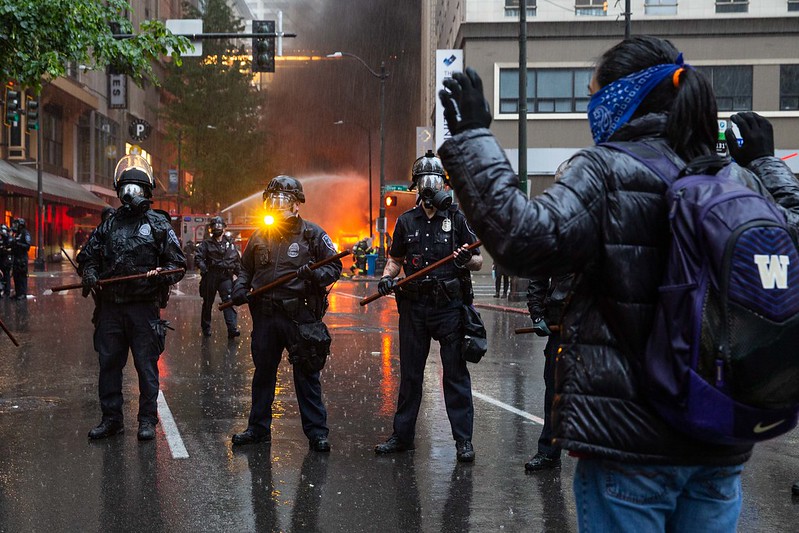
In recent weeks, the report “The Role of Police in Preventing Mass Human Rights Violations” has been presented to the international political public at several events. A launch event in New York, attended by representatives of more than 30 UN missions and 8 UN organizations, kicked off the series of dissemination activities on 25 April. The Permanent Missions of Colombia and Ireland to the UN co-hosted the event.
The report on the role of police, led by Rachel Neild, presents the results of one workstream in the Prevention Project, which former UN Special Rapporteur Pablo de Greiff from the Center for Human Rights and Global Justice at NYU Law School initiated with his team in 2020 and has been directing since then.
The Prevention Project combines basic research with policy advice and practice transfer. Within a sectoral framework, it formulates recommendations for the UN's 'New Agenda for Peace' and for states that pursue the goal of preventing human rights violations. In the area of state security forces, the current report proposes preventive measures including the development of clear guidelines for police areas of responsibility, the promotion of de-escalating police measures, better training of police forces in preventive behavior, the implementation of clear chains of responsibility and the establishment of effective control mechanisms.
While the report focusing on the police has just come out, the project work on other areas of practice is continuing: In six thematic working groups, the lead researchers for the Prevention Project are systematically investigating context-dependent prevention strategies. The preparation of the reports is supported by international expert committees made up of academics and practitioners. In regular consultations, they discuss research findings with other members of the committee, the project management and the team of authors.
As a member of the expert group in the Security Working Group, Sabine Mannitz contributed to the preparation of the current report.