


Insight Interview: Research on Colombia's Peace Process
In Conversation with Laura Camila Barrios Sabogal
In PRIF Insight, Laura Camila Barrios Sabogal discusses her research findings on the peace process in Colombia. Since 2023, she has visited rural communities several times to study the local reintegration of former FARC-EP combatants. Laura Camila Barrios Sabogal is a Doctoral Researcher in the Intrastate Conflict Research Department.

Your dissertation focuses on the integration of armed combatants into society. Can you briefly outline your topic? What was your initial research question, and what is your most important finding?
Using Colombia as a case study, I examine what helps former combatants of the FARC-EP (Fuerzas Armadas Revolucionarias de Colombia – Ejército del Pueblo) to permanently reintegrate into civilian life following the 2016 peace agreement – and what hinders or even jeopardizes this process.
My key finding: Reintegration is more than just the implementation of government programs or a new job for former combatants. What matters most is whether former combatants can organize collectively and have access to land. Equally important is how people in the surrounding communities react to them, what roles are assigned to women and men, and how safely they live. Sustainable reintegration thus arises from the interplay between the state, the community, and local relationships – and it is always shaped by existing power dynamics.
The idea of sustainable peace is at the center of many PRIF debates this year. How do your research findings fit into this – and what can we learn from Colombia about the prerequisites for lasting peace?
A peace agreement is an important first step, but signing it alone does not create lasting peace. Peace is not a state achieved on paper, but an ongoing, collective process that must be lived out in everyday life and continually reshaped.
Peace is not a state achieved on paper, but an ongoing, collective process that must be lived out in everyday life and continually reshaped.
Lasting peace therefore requires that reintegration processes not only endure over the long term but also be able to adapt to changing conditions – despite institutional hurdles, limited resources, and ongoing security risks. It is crucial that former combatants be able to continue their transition to civilian life and that their re-involvement in armed violence be prevented. At the same time, reintegration should help foster social acceptance, enable trust and reconciliation, and create new forms of coexistence. Sustainability, therefore, cannot be measured solely by whether a process formally continues, but also by the changes it enables and whether these changes are long-lasting.
Furthermore, peace does not mean the same thing to everyone. How people experience it depends on the violence and insecurity they have endured and how their lives have changed since then. War and peace also do not always follow one another in a clear sequence: while some people are building a civilian life, violence continues in other regions. The current challenges in implementing the agreement – particularly regarding security and access to land – clearly illustrate this.
For me, this is a key lesson from Colombia: Peace is multifaceted and arises neither solely through the state nor solely through local initiatives. The state creates the framework, and the people on the ground bring it to life. However, they cannot solve problems such as lack of access to land or ongoing insecurity on their own. It requires reliable institutions, long-term investments, and room for local actors to operate.
You developed the brochure “La paz integral” to share your research findings with the participants. How did you go about it?
It was important to me not only to publish the results of my research in academic articles but also to make them accessible to the people who shared their experiences and perspectives with me. The Spanish-language brochure serves as a bridge for knowledge transfer between academia and the local population and is intended to help strengthen local peace processes in a more targeted way, without oversimplifying the complexity of on-the-ground experiences.
“La paz integral” is based on a study examining how women and men experience conflict and peace, how they perceive the peace process and the reintegration of former FARC-EP combatants, and what roles they play in local peace efforts.
I view both the brochure and the exhibition not only as formats for knowledge transfer, but also as opportunities to make local knowledge and people’s experiences more visible and to promote dialogue between academia and society.
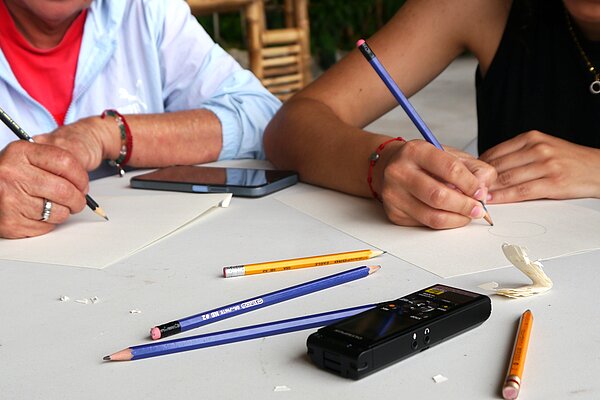
Methodologically, I worked with corporographies – visual representations that allowed the participants to express their experiences in a body-centered way. To do this, within body outlines, they drew the marks the conflict had left on their bodies and what peace means to them. This allowed the physical and emotional dimensions of their experiences to be incorporated into the analysis alongside their assessments. At the same time, it became clear how conflict and peace processes affect their lives.
To complement the brochure, I organized a photo exhibition in Frankfurt based on the body-mapping process, which was accompanied by a public discussion. The aim was to bring the perspectives gained during the research process into broader societal debates on peacebuilding. I view both the brochure and the exhibition as formats for knowledge transfer and as opportunities to make local knowledge and people’s experiences more visible and to promote dialogue between academia and society.
What role did the German-Colombian peace institute CAPAZ – a partner of PRIF – play in your research?
A very important one. The Instituto Colombo-Alemán para la Paz (CAPAZ) is a networking platform for scholars and universities from Colombia and Germany who focus on peace research, coming to terms with the past, the culture of remembrance, conflict prevention, and the shaping of a post-conflict society. Because I coordinated two projects funded by CAPAZ, I was able to deepen my engagement with the Colombian peace process over several years and further develop my empirical research in collaboration with partners in and from Colombia. This enabled me to travel to Colombia repeatedly over several years, maintain contact with the people there, incorporate their experiences into my research, and continue to learn from them. This continuity was crucial for my dissertation.
In addition, I was able to present three papers at CAPAZ’s conferences for early-career researchers, all of which were incorporated into my dissertation. The feedback I received there significantly strengthened my argumentation.
For me, CAPAZ also symbolizes the importance of German-Colombian academic cooperation, which creates spaces for the exchange of knowledge and brings together different perspectives. This cooperation enables research that links scholarly findings with the challenges of peacebuilding on the ground.
This year marks the 10th anniversary of the peace agreement between the government and the FARC-EP. At the same time, violent clashes in Colombia have been on the rise for the past few years. What can the international community do to support the agreement?
The international community should use this anniversary to reaffirm its support for the full implementation of the agreement and to demonstrate its long-term commitment to it. The agreement has brought about significant change. However, the ongoing violence shows just how fragile this progress is as long as key commitments remain unfulfilled.
In my view, four things are important:
First, reliable political and financial support is needed, especially for access to land, for economic opportunities in the affected regions, and for local institutions.
Second, former combatants, their families, social activists, and local communities must be protected. Crimes must not go unpunished. This includes strengthening the “Special Jurisdiction for Peace” (Jurisdicción Especial para la Paz – JEP), which was established in 2016. This institution investigates the most serious crimes, upholds victims’ rights, and is intended to ensure that such acts are not repeated. To do so, it needs political independence and adequate funding. Without security, justice, and recognition of the suffering endured, reintegration and reconciliation remain at risk.
The international community should use this anniversary to reaffirm its support for the full implementation of the agreement and to demonstrate its long-term commitment to it.
Third, the international community should continue to critically monitor implementation, identify progress and setbacks, and promote dialogue between the government, civil society, and the people in the regions. In addition to formal commitments, this should also involve the perspectives of those who are shaping peace on the ground.
Fourth, the international community should work to ensure that a change in government does not undermine the structures established since 2016. The agreement is a commitment that transcends individual governments. Joint projects, processes of coming to terms with the past, economic livelihoods, social relationships, and new civic identities require continuity and protection.
International support and government policy should not only ensure the agreement’s implementation but also strengthen the conditions under which people can build a civilian life and establish lasting peaceful relationships despite ongoing insecurity.
International support and government policy should not only ensure the agreement’s implementation but also strengthen the conditions under which people can build a civilian life and establish lasting peaceful relationships despite ongoing insecurity. The responsibility lies primarily with Colombian institutions and the parties to the agreement. However, the international community can help ensure that commitments are honored and that those working for peace are not left to fend for themselves.