


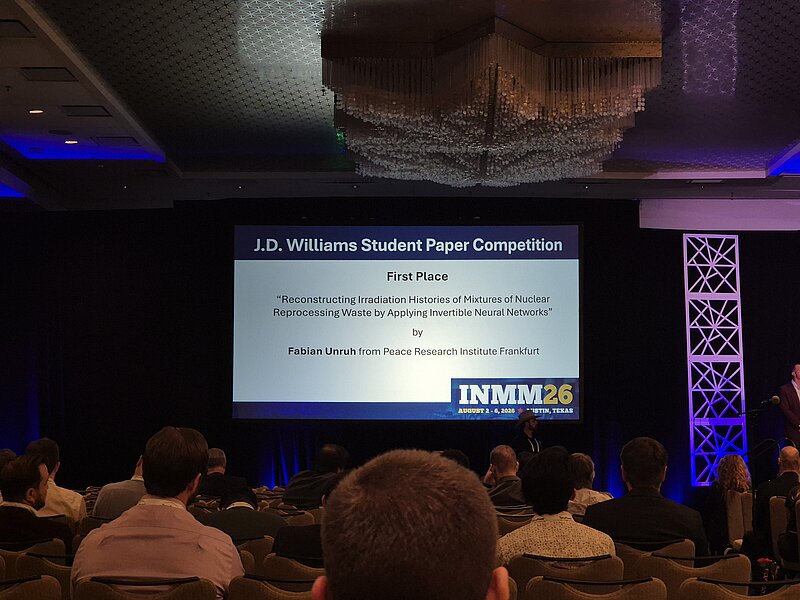
How can artificial intelligence (AI) be used to verify compliance with nuclear arms control agreements? Fabian Unruh investigated the potential of invertible neural networks (INNs) for reconstructing plutonium production in nuclear reactors. For this work, he was awarded first prize in the J.D. Williams Student Paper Competition at the 67th Annual Meeting of the Institute of Nuclear Materials Management (INMM) in Austin, Texas.
Invertible neural networks (INNs) are a special form of AI: they utilize a mathematical structure in which every calculation can be reversed. This makes it possible to train INNs to solve a specific class of mathematical problems. In his paper, Fabian Unruh examines how this approach can be applied to the analysis of highly radioactive waste generated during plutonium production in nuclear reactors. Accordingly, INNs could contribute to reconstructing past plutonium production in nuclear reactors – and thus to verifying compliance with nuclear arms control and disarmament agreements.
For this work, the Doctoral Researcher in the Cluster for Natural and Technical Science Arms Control Research (CNTR) was awarded the J.D. Williams Best Student Paper Award by the Institute of Nuclear Materials Management (INMM).
With the award, the professional association – which internationally promotes the responsible use of nuclear and radioactive materials – annually recognizes outstanding student research achievements in the fields of nuclear material management, nonproliferation, and monitoring.
The award recognizes both the best submitted paper and the contestant’s presentation at the Annual Meeting. The award is named after former INMM President James D. Williams.