Rapid advancements in artificial intelligence are transforming military operations across the board. As seen in conflicts like Ukraine and Iran, AI-driven applications are already reshaping warfare. For Europe, this presents a dual challenge: keeping pace in the global AI race to strengthen defense capabilities while preventing escalation and advancing the regulation of military AI.
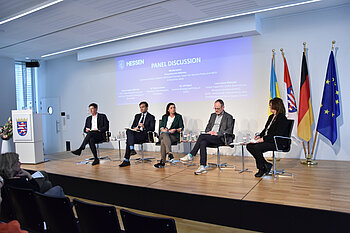
This tension was the focus of the panel discussion “Using Military AI Responsibly and Rethinking Regulation” – part of the Crisis Talks series – held at the Hessian State Representation in Brussels.
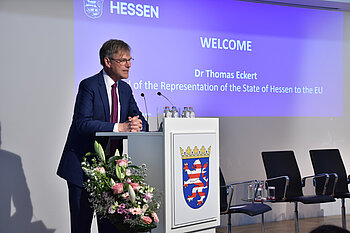
Thomas Eckert, Head of the Hessian State Representation, emphasized the relevance of the topic and the urgency of having the debate in his opening remarks. The was also evident from the resonance to the event, with over 270 guests from politics, academia, industry, civil society, and media registering.
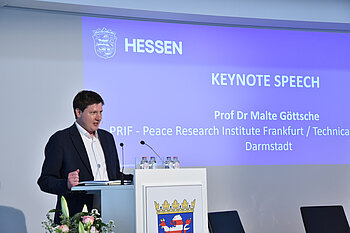
In his keynote, Malte Göttsche framed the current moment as the “Oppenheimer moment of our generation” – a reference to former Austrian Foreign Minister Schallenberg – highlighting how AI-powered weapons systems could prove as transformative as the creation of the atomic bomb in the 20th century.
AI is not only revolutionizing logistics, training, and information exchange but is also playing a direct role in combat, influencing target selection and decision-making. Despite claims that AI could reduce civilian casualties, the reality in ongoing conflicts tells a different story, with high civilian death tolls persisting. Additionally, AI-driven acceleration of decision cycles reduces time for diplomacy, increasing escalation risks. Studies, such as one from King’s College, show that AI models frequently recommend nuclear threats or even strikes in simulated crises. Furthermore, AI applications in biological and chemical research could lower the threshold for developing weapons of mass destruction.
Göttsche’s keynote drew on key findings from the CNTR Monitor 2025, “New Realities of AI in Global Security.” While the report identifies risks, it also offers recommendations for regulating military AI. The EU’s AI Act largely excludes military applications and research, leaving a critical regulatory gap. One potential starting point is joint security assessments of new high-performance AI models, where governments, researchers, and developers collaboratively evaluate misuse risks and system robustness.
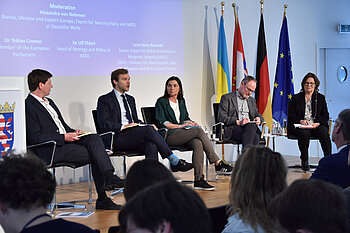
The subsequent discussion, moderated by Alexandra von Nahmen, explored challenges and potential approaches to future AI regulation.
MEP Tobias Cremer noted that regulation consistently lags behind technological progress, stressing the need to accelerate debates. However, he acknowledged a classic collective action problem: while cooperation benefits all, individual advantages often lead to competitive dynamics that hinder joint efforts.
Lene Hove Rietveld, Senior Expert on Lethal Autonomous Weapons Systems (LAWS) at the European External Action Service, highlighted existing soft law processes, such as the REAIM Summit (Responsible AI in the Military Domain). She also recognized Europe’s pioneering role with the AI Act but noted that unanimous decision-making slows down fast solutions.
Ulf Ehlert, Head of Strategy and Policy at NATO’s Science and Technology Organization, argued that it should not be those who are technologically the most advanced who get to define the rules. Instead, willing partners must come together to define at least minimum standards. Regulation should be designed to serve and protect our values. Given AI’s rapid evolution, regulation should focus on application areas rather than specific technologies.
Göttsche also addressed the role of research, emphasizing that fields like biology and chemistry involve extensive dual-use potential. He called for greater awareness and support structures within academia, as individual researchers often lack the expertise to navigate complex ethical dilemmas. Enhanced dialogue among governments, parliaments, scientists, and industry is essential.
The panelists agreed that debates must be demystified and broadened to include society at large. Regulation should neither stifle innovation nor fall behind due to the pace of technological change.
The Crisis Talks series is organized by the Leibniz Research Network “Environmental Crises – Crisis Environments” and the Representation of the State of Hesse to the EU in Brussels. Also involved are the Leibniz Association's Europe Office and the Research Center Normative Orders of the Goethe University Frankfurt. PRIF has been the lead coordinator of the Leibniz Research Network since 2021. The network builds on the work of the Leibniz Research Alliance “Crises in a Globalized World” which was established in 2013.
Program:
- Welcome: Dr. Thomas Eckert, Head of the Hessian State Representation to the EU
- Keynote: Prof. Dr. Malte Göttsche, PRIF/TU Darmstadt
Panel Discussion:
- Dr. Tobias Cremer, Member of the European Parliament
- Dr. Ulf Ehlert, Head of Strategy and Policy, NATO Science and Technology Organization
- Lene Hove Rietveld, Senior Expert on LAWS, European External Action Service
- Prof. Dr. Malte Göttsche
Moderation: Alexandra von Nahmen, Director for Russia, Ukraine, and Eastern Europe; Security Policy and NATO Expert, Deutsche Welle
Images: © Hessische Landesvertretung.